


BIENVENIDOS









Beyond treaty paralysis: an appeal for immediate federal action in Europe
26/january/2026
To:
The European Institutions (Antonio Costa, President of the European Council),
Political Leaders of the European Union,
and European Citizens,
From:
The Federalist Alliance of European Federalists (FAEF)
Following the recent proposal addressed to the President of the European Council, Antonio Costa, concerning Europe’s strategic sovereignty [1], we consider it our responsibility to address Europe’s institutions, political leadership, and citizens with clarity, urgency, and candour.
We share the diagnosis that Europe is facing an existential moment. The deterioration of transatlantic relations, mounting coercion at Europe’s Atlantic and Arctic frontiers, and sustained aggression along its eastern borders have revealed a reality that can no longer be obscured by diplomatic language: Europe’s security, territorial integrity, and democratic way of life are now directly at risk.
Where we fundamentally diverge, however, is on the proposed remedy.
The call to initiate yet another process of Treaty reform under present conditions represents a costly misallocation of time and political energy. Europe has already paid a high price for this approach. The Convention on the Future of Europe (2002–2003) lacked the courage to draft a genuine federal constitution and instead produced another intergovernmental treaty, misleadingly labelled a “Constitutional Treaty.” Its rejection by European citizens settled the matter.
Europe does not suffer from a shortage of legal texts, procedural clauses, or declaratory commitments. It suffers from the persistent illusion that treaty-based intergovernmental cooperation can deliver sovereign outcomes in a world increasingly shaped by power, speed, and confrontation.
History is unequivocal. The League of Nations failed because it relied on voluntary coordination without enforceable sovereignty. The United Nations remains structurally paralysed for the same reason. Despite its achievements, the European Union is now confronting the same systemic limit. A treaty-based association of formally sovereign states has not worked, does not work, and will not work under conditions of geopolitical rupture and strategic coercion. Persisting along this path risks repeating well-documented failures. This model must therefore be abandoned—now, not after another decade of conventions, ratifications, and vetoes.
As argued in our recent article From Managed Chaos to Shared Sovereignty: Why Europe Must Federalize in a Fragmenting World [2,3], Europe’s problem is not legal incapacity but political reluctance. Specifically, it is the reluctance to act commensurately with the threats it faces by abandoning the weak intergovernmental framework inaugurated in 1950 with the Schuman Declaration and replacing it with a structurally federal system, centred on a federal constitution ratified directly by the citizens of each participating state.
The independence of European states, territories, and peoples—who belong to a shared socio-cultural continuum and aspire to deeper unity grounded in the rule of law, liberal democracy, fairness, and sustainability—is under direct pressure along Europe’s Atlantic, Arctic, and eastern borders. These pressures stem from distinct yet convergent authoritarian challenges that do not respond to hesitation, incrementalism, or rhetorical diplomacy. They respond only to actors they recognise as strategic equals.
Achieving such parity does not require reopening the Treaties. It requires using the instruments that already exist. Article 20 of the Treaty on European Union, concerning Enhanced Cooperation, was designed precisely for moments of systemic impasse. It allows those states willing and able to act together to move beyond intergovernmental coordination toward a constitutionally grounded federation endowed with genuine executive, fiscal, and defence powers, and accountable to democratic institutions.
Europe cannot afford to behave like the owner of a damaged vessel endlessly debating new navigation rules while refusing to repair the hull. A ship that is not repaired in time will eventually sink—regardless of how sophisticated its charts may be. Delay today is not neutrality; it is strategic self-sabotage.
What is required is prompt and decisive action by a core group of states prepared to assume shared sovereignty in defence, security, foreign policy, and strategic capabilities. This means moving immediately toward a federal political structure for those willing to proceed, rather than remaining hostage to unanimity, conflicting national interests, vetoes, and the lowest common denominator.
Europe’s choice is stark. Either it becomes a sovereign political actor through federation, or it remains a fragmented space managed by others. The time for procedural caution has passed. The time for constitutional courage has arrived.
Between October 2021 and March 2022, the Federal Alliance of European Federalists (FAEF) convened a Citizens’ Convention mandated to draft a concise, ten-article Constitution for the Federated States of Europe. This constitutional draft provides a credible and immediately available starting point, open to timely amendment where necessary.
With respect and urgency,
The Federal Alliance of European Federalists (FAEF):
Manuel Galiñanes, President
Mauro Casarotto, Secretary
Peter Hovens, Treasurer
Leo Klinkers, Former President
Javier Giner
Martina Scaccabarozzi
Herbert Tombeur
References
-
Domènec Ruiz Devesa, et al. 2026. Proposal for Real Strategic Sovereignty in view of the transatlantic breakup. Euractiv. Brussels, 21 January 2026.
-
Manuel Galiñanes, Mauro Casarotto, and Leo Klinkers. 2026. Europe’s Federal Moment: Greenland, Article 20 Treaty on European Union, and the Limits of Alliance Politics. TRANSCEND Media Service. 19 January 2026. https://www.transcend.org/tms/2026/01/europes-federal-moment-greenland-article-20-treaty-on-european-union-and-the-limits-of-alliance-politics/
-
Manuel Galiñanes, Mauro Casarotto, and Leo Klinkers. 2026. Europe’s Federal Moment: Greenland, Article 20 Treaty on European Union, and the Limits of Alliance Politics. TRANSCEND Media Service. 21 January 2026. https://www.europetodaymagazine.eu/2026/01/21/europes-federal-moment-greenland-article-20-teu-and-the-limits-of-alliance-politics/
-
The making of the Constitution of the Federated States of Europe. 2022. https://www.iustitiascripta.com/product-page/the-making-of-the-constitution-for-the-federated-states-of-europe
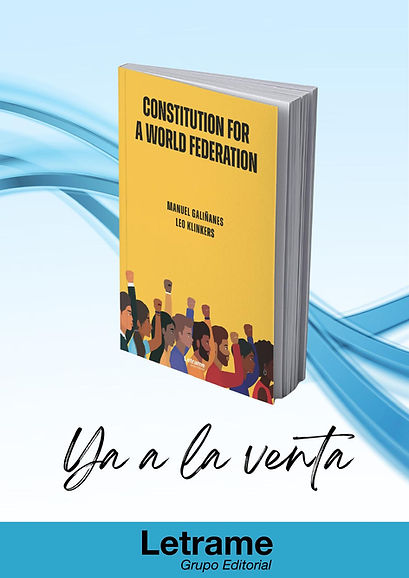
The book "Constitution for a World Federation" is now on sale.
Authors: Manuel Galiñanes - Leo Klinkers
Europe’s Federal Moment: Greenland, Article 20 Treaty on European Union, and the Limits of Alliance Politics
EUROPE, 19 Jan 2026
Manuel Galiñanes, Mauro Casarotto and Leo Klinkers – TRANSCEND Media Service
18 Jan 2026 – Recent statements and actions by the United States (U.S.) and the European Union (EU) reveal a world drifting toward a new and unsettling equilibrium. The proliferation of crises—from Ukraine and Gaza to Taiwan, Venezuela, and now Greenland—does not merely signal disorder. It reflects the emergence of an international system increasingly shaped by great powers seeking to preserve influence amid relative decline or contested primacy.
What is taking shape is not a rules-based order under strain, but a logic of managed instability, in which crises are contained, instrumentalized, and selectively prolonged rather than resolved. Greenland, a European territory whose sovereignty has been openly questioned by an ally, exposes this reality with unusual clarity. When security guarantees depend less on constitutional commitments than on the discretion of dominant powers, Europe’s fragmentation becomes not just a weakness, but a liability. The question Europe now faces is whether it will continue to rely on external restraint—or finally assume shared sovereignty over its own security.
U.S. foreign policy today is marked by a paradoxical combination of assertiveness and restraint. On the one hand, Washington relies heavily on economic coercion, sanctions, extraterritorial regulation, and the threat of military force to sustain its global position. On the other, it avoids decisive commitments where escalation might impose unacceptable political, economic, or military costs. This dual strategy suggests less a consistent defense of universal norms than an attempt to manage relative decline by shaping the conditions under which instability unfolds.
The recent U.S. posture toward Venezuela illustrates this pattern clearly. Framed in the language of democracy, security, and regional stability, Washington’s actions revive a hemispheric logic reminiscent of the Monroe Doctrine at precisely the moment when Chinese investment and Russian diplomacy have expanded their footprint across Latin America [1,2]. The underlying message is unmistakable: certain regions remain non-negotiable for U.S. influence, even as the U.S. continues to present itself as the guardian of a universal international order.
A similar logic governs U.S. engagement in Eastern Europe. Since Russia’s invasion of Ukraine, Washington has provided extensive military, financial, and intelligence support, yet carefully calibrated to avoid direct confrontation with Moscow. The result has been a prolonged war of attrition that weakens Russia strategically while leaving Ukraine devastated and Europe exposed to profound economic, social, and security shocks [3,4]. The conflict is managed rather than resolved, with its human and material costs externalized largely onto Ukrainians and European societies.
That Europe’s governments—and their collective expression in the EU—appeared surprised by this outcome reveals a deeper failure. Basic historical knowledge of how autocratic regimes consolidate power and exploit strategic hesitation should long ago have led Europe to close ranks politically. A quietly established European defence capability, independent but not hostile to the U.S., could have mitigated Europe’s vulnerability. Instead, strategic dependence persisted.
In the Middle East, U.S. policy reflects another form of selective principle. Washington’s unwavering diplomatic and military support for Israel—despite mounting evidence of violations of international humanitarian law in Gaza and the West Bank—has further eroded Western credibility on human rights and legal consistency [5]. Once again, alliance management and regional stability outweigh the universal norms the U.S. formally endorses.
East Asia completes the picture. The long-standing U.S. policy of “strategic ambiguity” toward Taiwan—arming the island while withholding an explicit security guarantee—was once justified as deterrence. Today, it increasingly resembles a tacit acknowledgment of China’s core interests combined with an effort to postpone rather than prevent confrontation [6]. Taken together, U.S. restraint in Ukraine, permissiveness in the Middle East, and ambiguity in East Asia lend credibility to a troubling hypothesis: the gradual emergence of an undeclared tripolar accommodation among the U.S., China, and Russia.
This logic echoes, uncomfortably, Carl Schmitt’s concept of Großraum—“great spaces” dominated by a central power (Reich) that defines political order within its sphere [7]. While Schmitt’s theory emerged from an explicitly authoritarian and imperial worldview, its analytical relevance lies in describing how power politics displace universal norms. In today’s context, spheres of influence are not declared, but tolerated. International law survives rhetorically, while its application becomes selective.
Russia asserts dominance in parts of Eastern Europe and Central Asia; China consolidates influence in East Asia and the South China Sea; and the U.S. reasserts primacy in the Western Hemisphere, the Arctic, and key maritime chokepoints. Smaller states pay the price—unless they recognize that their survival depends not on isolated sovereignty, but on federal political organization capable of collective self-defense.
It is within this emerging order that Europe’s strategic weakness becomes existential. Despite its economic weight and normative ambitions, the EU is not recognized as a geopolitical pole. Fragmented sovereignty, unanimity requirements, and limited defence integration render it largely reactive—even when its own interests are directly implicated [8,9]. Europe’s hesitant responses to Venezuela, Ukraine, and the Middle East already reveal this deficit. The U.S. threat to annex Greenland exposes it in stark and destabilizing terms.
U.S. President Donald Trump’s repeated assertions that the U.S. “needs” Greenland for national security—combined with his refusal to rule out the use of force—represent more than rhetorical excess. They reveal how great-power anxiety can spill into direct threats to allied sovereignty. Greenland’s strategic importance is undeniable: its position on the shortest route between North America and Europe, its missile early-warning systems, and its growing relevance as Arctic ice melts make it central to transatlantic security [10.11].
Yet the paradox is striking. Trump first floated the idea of acquiring Greenland in 2019, later demanded that NATO members increase defence spending by five percent of GDP to strengthen collective security, and now undermines that very security by threatening to annex the territory of a NATO ally. The logic is self-contradictory. If security is the objective, it can be achieved within NATO. Annexation would do precisely the opposite.
It is also cynical. Trump has justified annexation by invoking the risk that Russia or China might seek control over Greenland—while proposing to do exactly that for U.S. benefit. The thinly veiled agenda of exploiting Greenland’s natural resources is unacceptable conduct toward an ally. This is naked power politics, not collective defence.
European leaders have rightly treated this prospect as existential—though dangerously late. Danish and Greenlandic authorities have categorically rejected any transfer of sovereignty. German and French policymakers have warned that such an act would undermine NATO’s foundational principle: that an attack on one is an attack on all. Even within the U.S., public opinion overwhelmingly opposes annexation.
The Greenland episode crystallizes a lesson repeatedly taught by history and repeatedly ignored. Alliances based on goodwill rather than binding constitutional commitments are inherently fragile. Europe can no longer assume that its security is guaranteed by external actors whose strategic calculations may abruptly diverge from European interests. In a world of managed instability, reliance without sovereignty becomes a liability.
The world Europe now confronts is no longer one in which restraint can be assumed or security outsourced without cost. A system organized around managed instability, informal spheres of influence, and unilateral security claims leaves little room for a Europe that remains politically fragmented while strategically exposed. Greenland has made this unmistakably clear. When the sovereignty of a European territory can be publicly questioned by an ally, the issue is not diplomatic miscalculation—it is constitutional vulnerability. Dependence without sovereignty is no longer a viable foundation for European security.
Europe does not suffer from a lack of legal capacity, but from a reluctance to act commensurately with the threats it faces. The independence of European states, territories, and peoples who belong to a shared socio-cultural continuum—and who aspire to deeper unity grounded in the rule of law, liberal democracy, fairness, and sustainability—is now under pressure along Europe’s Atlantic, Arctic, and eastern borders. These pressures emanate from distinct yet convergent authoritarian challenges that do not respond to hesitation or rhetorical diplomacy, but only to actors they recognize as strategic equals. Achieving such balance requires those European states prepared to advance together to move beyond intergovernmental coordination toward constitutionally grounded federation. Article 20 of the Treaty on European Union (“Provisions on Enhanced Cooperation”) was designed precisely for this purpose:
“1. Member States which wish to establish enhanced cooperation between themselves within the framework of the Union’s non-exclusive competences may make use of its institutions and exercise those competences by applying the relevant provisions of the Treaties, subject to the limits and in accordance with the detailed arrangements laid down in this Article and in Articles 326 to 334 of the Treaty on the Functioning of the European Union.
-
The decision authorising enhanced cooperation shall be adopted by the Council as a last resort, when it has established that the objectives of such cooperation cannot be attained within a reasonable period by the Union as a whole, and provided that at least nine Member States participate in it. The Council shall act in accordance with the procedure laid down in Article 329 of the Treaty on the Functioning of the European Union.
-
All members of the Council may participate in its deliberations, but only members of the Council representing the Member States participating in enhanced cooperation shall take part in the vote. The voting rules are set out in Article 330 of the Treaty on the Functioning of the European Union.
-
Acts adopted in the framework of enhanced cooperation shall bind participating Member States. They shall not be regarded as part of the acquis which has to be accepted by candidate States for accession to the Union.” [12]
In this way, a group of at least nine Member States is allowed to proceed to enhanced cooperation when unanimity obstructs action vital to collective security and sovereignty. Far from undermining European unity, such a federal core would constitute its most credible safeguard—offering constitutional authority where discretionary goodwill and treaty assurances alone no longer suffice, and potentially inaugurating a broader federalisation of the European continent.
A European Federation need not emerge all at once, nor require immediate participation by all Member States. It can begin with those willing to share authority over defense, foreign policy, and strategic decision-making, fully within the EU’s legal framework. Such a step would not weaken alliances, but rebalance them—restoring Europe as a credible political subject rather than a dependent space.
Beyond Europe, the implications extend further. In an international system drifting toward partition and power-based accommodation, a federal Europe could offer a constitutional alternative grounded in shared sovereignty and democratic accountability. As argued in the World Constitution proposed by Galiñanes and Klinkers [13], stable global order cannot rest on informal bargains among great powers alone, but on federated structures capable of cooperation without domination.
The choice before Europe is therefore no longer abstract. It is constitutional and immediate. Greenland has exposed the cost of delay. Article 20 TEU provides a lawful and democratic starting point. The remaining question is whether Europe will continue to navigate managed chaos—or take responsibility for shared sovereignty.
References:
-
Walt, S. M. (2018). The Hell of Good Intentions: America’s Foreign Policy Elite and the Decline of U.S. Primacy. New York: Farrar, Straus and Giroux.
-
Farrell, H., & Newman, A. (2019). “Weaponized Interdependence.” International Security, 44(1), 42–79.
-
Mearsheimer, J. J. (2014). “Why the Ukraine Crisis Is the West’s Fault.” Foreign Affairs, 93(5), 77–89.
-
Posen, B. (2014). Restraint: A New Foundation for U.S. Grand Strategy. Ithaca: Cornell University Press.
-
Rachman, G. (2022). The Age of the Strongman. London: Bodley Head.
-
Gaddis, J. L. (2018). On Grand Strategy. New York: Penguin Press.
-
Schmitt, C. (2009 [1941]). Völkerrechtliche Großraumordnung. Berlin: Duncker & Humblot.
-
Zielonka, J. (2014). Is the EU Doomed? Cambridge: Polity Press.
-
Biscop, S. (2021). Grand Strategy in 10 Words: A Guide to Great Power Politics in the 21st Century. Bristol: Bristol University Press.
-
(2026). “Trump Says U.S. Needs Greenland for Security.”
-
Dodds, K., & Nuttal, M. (2021). The Scramble for the Poles: The Geopolitics of the Arctic and Antarctic. Cambridge: Polity Press.
-
European Union. Consolidated Version of the Treaty on European Union, Article 20, Official Journal of the European Union, C 326, 26 October 2012.
-
Galiñanes, M., & Klinkers, L. (2026). Constitution for a Wotld Federation. Letrame Publisher.
_____________________________________________________
Manuel Galiñanes: President of the Federal Alliance of European Federalists (FAEF)
Mauro Casarotto: Secretary-General of the FAEF
Leo Klinkers: Former President of the FAEF
Venezuela and the Collapse of a World Order Built on Treaties
TMS PEACE JOURNALISM, 12 Jan 2026
Manuel Galiñanes and Leo Klikers – TRANSCEND Media Service
7 Jan 2026 – The crisis surrounding Venezuela exposes a recurring illusion in international politics: the belief that defending international law requires choosing between opposing external coercion and opposing internal authoritarianism. This is a false dilemma. A principled position does not select which abuses to condemn. It rejects all exercises of unchecked power, whether they originate outside a country’s borders or are imposed upon its population from within. The tragedy of Venezuela is not only the brutality of an authoritarian regime, but the way a treaty-based international order systematically fails to protect the people caught between geopolitical maneuvering and domestic repression.
Venezuela’s authoritarian collapse is often framed as a confrontation between Washington and Caracas. This framing is misleading. The deeper problem lies in the structure of the international system itself. Built almost entirely on treaties among sovereign states, that system lacks the democratic foundations, executive authority, and judicial capacity required to enforce its own principles. It is an order that speaks the language of law while operating through paralysis, discretion, and selective enforcement. Venezuela is not an exception to this order; it is one of its most revealing symptoms.
There is no question that coercive external actions—military threats, extraterritorial sanctions, or attempts at regime change—violate core principles of international law, including sovereign equality and the prohibition on the use of force enshrined in the Charter of the United Nations [1]. Such actions undermine legality rather than defend it. Yet condemning these practices while remaining silent about the conduct of Nicolás Maduro’s government is not neutrality. It is a moral abdication. Sovereignty was never intended to function as a shield for repression. Under international law, states are bound by obligations toward their own populations, including respect for civil and political rights, democratic participation, and judicial independence. Venezuela has voluntarily accepted these obligations through multiple international treaties, and those obligations do not evaporate when a government invokes anti-imperialist rhetoric.
The factual record is unequivocal. United Nations bodies have documented systematic patterns of arbitrary detention, torture, extrajudicial executions, enforced disappearances, and the criminalization of political dissent in Venezuela [2]. The Independent International Fact-Finding Mission on Venezuela has concluded that there are reasonable grounds to believe that crimes against humanity have been committed by state authorities [3]. International human rights organizations have corroborated these findings, describing a sustained dismantling of democratic institutions, manipulation of electoral processes, persecution of political opponents, and the forced displacement of millions [4, 5]. To ignore this reality while condemning external pressure does not advance peace or justice. It erases victims and empties human rights of their universal meaning.
The gravity of these violations has placed Venezuela within the jurisdiction of the International Criminal Court. In 2021, the ICC Prosecutor opened a formal investigation into alleged crimes against humanity committed since 2017 [6]. This was a crucial acknowledgment that what is happening in Venezuela is not merely a political dispute, but a matter of international criminal law. Yet the limits of the Court are equally evident. Its jurisdiction depends on state consent, its enforcement powers are weak, and its effectiveness is routinely constrained by political pressure and non-cooperation. The ICC represents moral and legal progress, but it operates within an international system that ultimately allows governments—especially powerful ones—to decide when law applies and when it does not.
Many still look to the United Nations as the guardian of global legality. But the UN’s failure in Venezuela is not accidental or temporary. It is structural. The Organization is bound by a Charter that entrenches executive dominance, state sovereignty, and veto power at the very heart of enforcement. Nowhere is this failure more clearly codified than in Article 6 of the UN Charter, which states:
“A Member of the United Nations which has persistently violated the Principles contained in the present Charter may be expelled from the Organization by the General Assembly upon the recommendation of the Security Council” [1].
This provision is a textbook example of institutional self-neutralization. Any serious application of Article 6 would require the Security Council to recommend the expulsion of some of its own permanent members—states that have repeatedly violated the Charter’s core principles. The result is permanent paralysis by design.
This paralysis is all the more indefensible because it rests on a broken promise. When the Charter was drafted in San Francisco in 1945, resistance to Article 6 was overcome by an explicit commitment to review and amend the provision after ten years, once experience revealed its shortcomings. That evaluation was due in 1954. It has never taken place. The so-called San Francisco Promise remains unfulfilled, while Article 6 stands as a lasting illustration of how treaty-based systems incapacitate themselves in the face of power.
The problem, therefore, is not unilateralism versus multilateralism. It is treaty-based governance itself. Treaties are negotiated, interpreted, and enforced by executives. They do not create genuine parliaments elected by citizens, democratic authorization of authority, or courts with the capacity to intervene directly when rights are violated. They rely on weak sanctions, voluntary compliance, and political bargaining. In such a system, autocrats exploit ambiguity, delay, and procedural complexity to entrench their rule. Deception and repression flourish precisely because the system lacks institutions capable of acting decisively in the name of peoples rather than governments.
This is not a Venezuelan problem. It is a systemic one. Politicians will always seek more power. That is a constant of political life. The decisive question is whether institutions are designed to restrain that power effectively. History shows that only two instruments can do so. The first is democratic federalization—structures that divide, balance, and legally bind authority across levels of government while grounding it in popular sovereignty. The second is a constitutional framework that requires those who aspire to political office to meet enforceable standards of competence, responsibility, and accountability.
A treaty-based world order possesses neither. It has no genuine global parliament elected by citizens, no executive authority capable of intervening to protect populations, and no judiciary with compulsory jurisdiction and effective enforcement power. As a result, peoples are exposed to a double vulnerability: repression by their own governments and instrumentalization by external powers that claim to act on their behalf.
From this perspective, Venezuela reveals the moral and institutional bankruptcy of the existing global order. The choice is not between opposing the United States or opposing Maduro. It is between accepting a system that tolerates both imperial overreach and domestic tyranny, or building one that subjects all political power to law.
The alternative is constitutional rather than utopian. A democratic world federation—grounded in a World Parliament elected by the world’s citizens, a binding system of world law, and an independent World Judiciary with compulsory jurisdiction over crimes against humanity—would reverse the logic of international politics [7, 8]. Under such a system, the Venezuelan people would be the primary subjects of international concern, not bargaining chips in a geopolitical struggle. Rights would be protected through lawful global institutions rather than through sanctions warfare or authoritarian impunity.
True international solidarity means standing with people, not regimes. It means defending Venezuelans imprisoned for dissent, journalists silenced, families forced into exile, and civil society dismantled. It also means rejecting the illusion that treaties among governments can substitute for democratic authority and enforceable law.
Venezuela is a warning. It shows what happens when an international system lacks the institutional courage to move beyond treaties toward constitutional governance. As long as global authority remains fragmented, executive-driven, and structurally unenforceable, injustice will persist and power will go unchecked. Only a democratic federal system—constitutional, enforceable, and grounded in popular sovereignty—can correct this foundational design failure.
References:
-
United Nations. 1945. Charter of the United Nations. San Francisco.
-
Office of the United Nations High Commissioner for Human Rights. 2019. Report on the Situation of Human Rights in the Bolivarian Republic of Venezuela. Geneva: United Nations.
-
United Nations Human Rights Council. 2020, 2022. Reports of the Independent International Fact-Finding Mission on the Bolivarian Republic of Venezuela. Geneva: United Nations.
-
Human Rights Watch. 2019. Venezuela’s Humanitarian Emergency: Large-Scale UN Response Needed. New York: Human Rights Watch.
-
Amnesty International. 2025. Venezuela: Enforced Disappearances Amount to Crimes Against Humanity. London: Amnesty International.
-
International Criminal Court. 2021. Situation in the Bolivarian Republico f Venezuela I. The Hague: ICC.
-
World Constitution and Parliament Association. Constitution for the Federation of Earth. Lakewood, CO: WCPA. http://worldparliament-gov.org/constitution
-
Galiñanes, Manuel, and Leo Klinkers. 2026. Constitution for a World Federation: A Worldwide Pact for Peace, Justice and Sustainability on Earth. In press.
_______________________________________________________________________________________
Manuel Galiñanes – Former president of the Federalist Alliance of European Federalists (FAEF)
Leo Klikers – President of FAEF

Autores: Dr. Manuel Galiñanes (1), Steffan Bernhardt (2) & Leo Klinkers (3)
(1) Academy of Medical and Health Sciences of Catalonia and the Balearic Islands, Barcelona, Spain;
President of the Federal Alliance of European Federalists (FAEF)
(2) Department of Politics and International Relations, University of Exeter, United Kingdom;
Staff Member of the Federal Alliance of European Federalists (FAEF)
(3) Consultant in Public Administration; State University Utrecht, Nederlands; Former President of the Federal Alliance of European Federalists (FAEF)
Correspondence: Manuel Galiñanes, President of FAEF.
Tel: 34-6-0982-9170. E-mail:
manuel.galinanes@gmail.com. ORCID iD: 0000-0002-0888-976X
Publicado en Journal of Politics and Law; Vol. 18, No. 4; 2025
Application is no longer available.

La Constitución española de 1978 ( https://www.boe.es/eli/es/c/1978/12/27/(1)/con ) esbozó el marco legal para la transición de España de una dictadura a una monarquía constitucional con un democracia parlamentaria. Se trató de un compromiso transicional entre posiciones antagónicas, y no de un proceso constituyente, que preservó la unidad del Estado y la formación de nacionalidades y regiones (las Autonomías) con un grado variable de autogobierno. Bajo este marco, el gobierno central mantiene cierta autoridad, al tiempo que otorga a las Autonomías competencias delegadas por el Estado. Cataluña y el País Vasco tienen un mayor nivel de autonomía en comparación con otras regiones de España. Algunos académicos se han referido a este modelo de Estado unitario descentralizado, donde el gobierno central tiene mayor autoridad que las regiones, como de tipo federal o “cuasi-federación”.
Durante las últimas elecciones generales del 23 de junio de 2023, y cumpliéndose 45 años de la promulgación de la Constitución de 1978, el Partido Popular (PP) consiguió el mayor número de votos. Sin embargo, fue el Partido Socialista Obrero Español (PSOE) el que logró obtener el mayor número de escaños en el Congreso de los Diputados formando un gobierno de coalición gracias a su colaboración con Sumar y el apoyo de los partidos independentistas catalán y vasco. El apoyo de los partidos independentistas catalán y vasco se obtuvo a cambio de una serie de pactos y concesiones del PSOE. Esto ha sido fuertemente cuestionado por los partidos de la oposición, diferentes asociaciones de jueces, fiscales y abogados del Estado, y también por la sociedad civil en general, lo que ha dado lugar a numerosas quejas y grandes manifestaciones públicas.
Dentro de los diferentes acuerdos para formar el nuevo Govern, ha suscitado especial preocupación la tramitación de una ley de amnistía a los políticos catalanes por las actuaciones emprendidas hacia la independencia de Cataluña durante la última década, el conocido como “procés” , debido a la grave degradación de principios democráticos. Existen diferentes motivos para el rechazo de la propuesta de amnistía, entre los que se incluyen:
-
a cambio del apoyo de los partidos independentistas, la coalición liderada por el PSOE ha aceptado indultar las infracciones cometidas por miembros de los partidos independentistas;
-
para que la coalición liderada por el PSOE obtenga el poder propondrá una ley de amnistía que requerirá la aprobación del Congreso de los Diputados;
-
los miembros de los partidos independentistas que hayan sido acusados de diversos delitos ilícitos serán absueltos sin haber cumplido íntegramente sus penas ni haber reconocido sus delitos; y
-
la admisión por parte del presidente del nuevo Gobierno de que se ha impulsado la amnistía para obtener los votos de los diputados de los partidos independentistas para formar el Gobierno del país, al tiempo que declara que tal decisión no hubieran sido tomadas si sus votos no hubieran sido necesarios.
La propuesta de amnistía es solicitada por la coalición liderada por el PSOE, pese a que fue declarada inconstitucional por los abogados del Congreso de los Diputados en marzo de 2021, que llamaron la atención sobre el artículo 62.i de la Constitución de 1978, que establece: “Corresponde al Rey : 62. Ejerzo el derecho de indulto de conformidad con la ley, que no podrá autorizar indultos generales” ( https://www.boe.es/eli/es/c/1978/12/27/(1)/con ).
Independientemente de cualquier debate sobre si la Constitución de 1978 permite la propuesta de amnistía, el aspecto más inquietante de las acciones emprendidas por la coalición del PSOE es la erosión de la separación de poderes mediante el mal uso del poder judicial para obtener beneficios políticos en la formación de Gobierno. . Esto ha motivado a diversas organizaciones a solicitar protección a las instituciones europeas para que se eviten los abusos antes mencionados y que en España se garanticen la equidad, la legitimidad y los principios democráticos que rigen la UE.
La degradación de la separación de poderes se produce en otros ámbitos de la política española, lo que devalúa la integridad democrática de las instituciones. Por ejemplo, en la elección de los miembros del Consejo General del Poder Judicial (CGPJ), la mitad del órgano de gobierno de jueces es elegido por el Congreso de los Diputados y la otra mitad por el Senado, en votación por mayoría cualificada de tres -quintos. Esto implica que los principales partidos políticos tienen que ponerse de acuerdo para realizar los nombramientos, algo que impide la independencia de la elección al proponer profesionales que suelen ser ideológicamente cercanos a los partidos políticos. Los miembros del CGPJ son nombrados para un mandato de cinco años pero actualmente, debido al intento de influir en los nombramientos, el órgano no ha sido renovado desde hace cinco años y el PP ha sido acusado de bloquear la elección del nuevo miembros. El bloqueo de la renovación del CGPJ también preocupa mucho a la Comisión Europea, que ha pedido abordar la situación de forma prioritaria, insistiendo al mismo tiempo en que el sistema electoral debe modificarse de acuerdo con los estándares europeos de tal manera que los miembros del CGPJ deben ser elegidos por los propios jueces (12 vocales reservados para jueces y magistrados y 8 elegidos entre juristas de prestigio), modelo que, en mayor o menor medida, se da en otros países de la UE.
Desgraciadamente, el control ejecutivo del poder judicial en España no se ha limitado al CGPJ y otras instituciones judiciales también han sido sometidas al mismo tipo de intrusión política. La propuesta del actual Gobierno de crear comisiones parlamentarias de investigación de las decisiones judiciales representa otra clara interferencia de los poderes ejecutivo y legislativo en el poder judicial. Por tanto, la falta de independencia del poder judicial en España es claramente una grave anomalía democrática.
También es necesario señalar que la fusión del poder ejecutivo (Presidente y ministros) con el poder legislativo (Congreso de los Diputados) en el sistema parlamentario español no corresponde a una separación estricta de ambos poderes. Sin embargo, se puede argumentar que esta integración no necesariamente viola la separación de poderes si se establecen mecanismos que sirvan como controles y contrapesos; sin embargo, el grado de superposición de poderes significa que la eficacia del sistema político depende de las disposiciones constitucionales y del compromiso de los actores políticos para defender los principios democráticos. Este no es el caso de España, donde la lucha por el poder transgrede frecuentemente estos principios, distorsionando la vida política, agravando y dividiendo a la sociedad civil.
Hay varios factores responsables del declive de la democracia, pero una cuestión central es qué papel juega el actual Estado unitario descentralizado en España. En primer lugar, hay que reconocer que este modelo “cuasi federalista”, que opera de arriba hacia abajo a partir de las instituciones gubernamentales, ha funcionado durante algún tiempo, permitiendo la transición pacífica de un Estado dictatorial a uno democrático, pero las deficiencias intrínsecas del modelo han terminado erosionando la actividad política y la integridad democrática de sus instituciones. Ahora la pregunta es ¿cómo se puede revertir el declive democrático para mejorar la gobernabilidad del país? En mi opinión, la alternativa más adecuada es la adopción de un Estado federal. En particular, si el modelo elegido es un federalismo centrípeto donde las decisiones se toman de abajo hacia arriba partiendo de los ciudadanos. En tal modelo, las diferentes regiones podrán gestionar sus propios asuntos delegando competencias comunes al Gobierno del Estado. Cabe señalar que un federalismo centrípeto es promovido por la Alianza Federativa de Federalistas Europeos (FAEF) en la redacción de la Constitución para la creación de los Estados Federados de Europa ( https://www.faef.eu/wp-content/ uploads/Final-Constitution.pdf ) para poner fin al déficit democrático que sufre la Unión Europea regida por tratados intergubernamentales.
Aceptando que la institución de una verdadera federación es el modelo más eficaz para preservar las diferentes identidades regionales, salvaguardar los principios democráticos y mejorar la gobernabilidad en España, cabe preguntarse cómo se puede implementar. Una forma rápida de hacer la transición desde el modelo existente de Estado unitario descentralizado será la modificación y actualización de la Constitución actual; sin embargo, la división entre los partidos y la falta de democracia dentro de los propios partidos pueden dificultar el logro de un acuerdo sobre las reformas constitucionales necesarias. Otra alternativa puede ser la apertura de un proceso constituyente para la redacción de una nueva Constitución en el que deban participar intelectuales independientes y la sociedad civil, con una ratificación final por parte de los ciudadanos en referéndum. Independientemente de la modalidad elegida, un Estado federal que funcione bien requerirá la provisión de estructuras gubernamentales apropiadas como se sugirió anteriormente (doi:10.4236/ojps.2023.134021; https://www.faef.eu/wp-content/uploads/Final-Constitution .pdf ) con los correspondientes controles y contrapesos y la participación directa de la ciudadanía.
Es más, para establecer un Estado federal en España es necesario tener en cuenta dos cuestiones importantes. El primero es el “mantenimiento de la unidad nacional” tal como se describe en el artículo 2 de la Constitución de 1978 ( https://www.boe.es/eli/es/c/1978/12/27/(1)/con ), así garantizar que todas las regiones de España permanezcan unidas como un solo país y no como naciones separadas. Una posible solución para superar este obstáculo puede ser el mantenimiento del principio de unidad nacional durante un período de tiempo suficiente para que los ciudadanos puedan evaluar los beneficios del modelo federalista antes de que el tema sea finalmente sometido a consulta ciudadana. Un segundo obstáculo podría ser la compatibilidad de la monarquía constitucional existente con un Estado federal. Sin embargo, en este caso, una monarquía constitucional puede ser compatible con un Estado federal ya que la forma de gobierno (monarquía constitucional) y la estructura del Estado (federalismo) son conceptos separados y, por tanto, ambos pueden coexistir dentro de un mismo sistema político. De hecho, varios países del mundo combinan una monarquía constitucional con una estructura federal donde el papel del monarca es ceremonial y la gobernanza y la toma de decisiones políticas son responsabilidad de los funcionarios electos.
En conclusión, el deterioro de la democracia en España ha alcanzado niveles alarmantes que amenazan la gobernabilidad del país y provocan zozobra entre los ciudadanos, situación que requiere soluciones imperiosas. La conversión del actual Estado unitario descentralizado, o Estado “cuasi federal”, en un verdadero Estado federal mediante una reforma consensuada o una nueva constitución, que defina claramente las responsabilidades de los diferentes poderes y la independencia entre ellos, es factible y puede ser la forma más viable y eficaz de proporcionar la legitimidad política y la estabilidad necesarias al país. Se espera que una implementación exitosa del federalismo en España estimule la transición de una Unión Europea regida por tratados a una Europa federal más democrática.
Manuel Galiñanes
Alianza Federal de Federalistas Europeos (FAEF)

